• iD2 Communications

    Situation

    Saanich Council had directed the Parks Division to develop a management plan for the Saanich-owned portion of Haro Woods, two parcels of land totalling 5.8 ha, with adjoining property owned by the CRD and the University of Victoria.

    The management plan required a guiding vision for the park, and clarity about its recreational role and natural areas strategy. An advisory group was established. The client was looking to get support from the public process for the management plan they created.

    We soon understood that the contentious issue was cycling and the building of jumps in the park. The jumps, some of which were dangerous to walkers on paths, compromised the health and sustainability of the forest.

    In addition, some stakeholders had been involved for years, even decades. They had worked on restoration of the land and lacked trust in the engagement process. Some believed that Saanich had an agenda. We also were trying to engage a local public who felt engagement processes were constant.

    Audience

    Saanich residents including neighbours who property adjoins the land, young families, youth, UVic students, destination cyclists, nature lovers, dog walkers, First Nations, and visitors to the area.

    Solutions
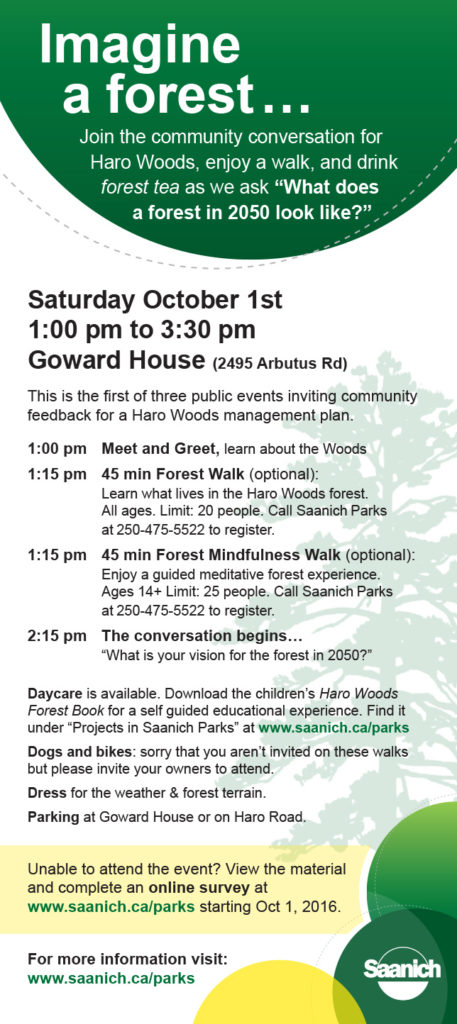
    Haro Woods - flyer

    Trust has been key to this process. We take the necessary time to build relationships between advisory group members and other stakeholders. We highlight commonalities and demonstrate how different perspectives don’t require opinions to be correct or incorrect. We exercise what consensus means so that the group can appreciate differing perspectives and agree that group decisions based on these perspectives are the best decisions that can be made at the time.

    The 18-month advisory group strategy includes varying activities to keep the advisory group engaged, from revolving conversations to field trips to cafés to fishbowl processes. When we meet challenges, we used revolving conversations to allow others to understand different perspectives. Eventually, while our advisory group was divided on one issue, they had grown to respect each other and felt there integrity in our process, so they agreed to accept the public input received, even when it might differ from their own position.

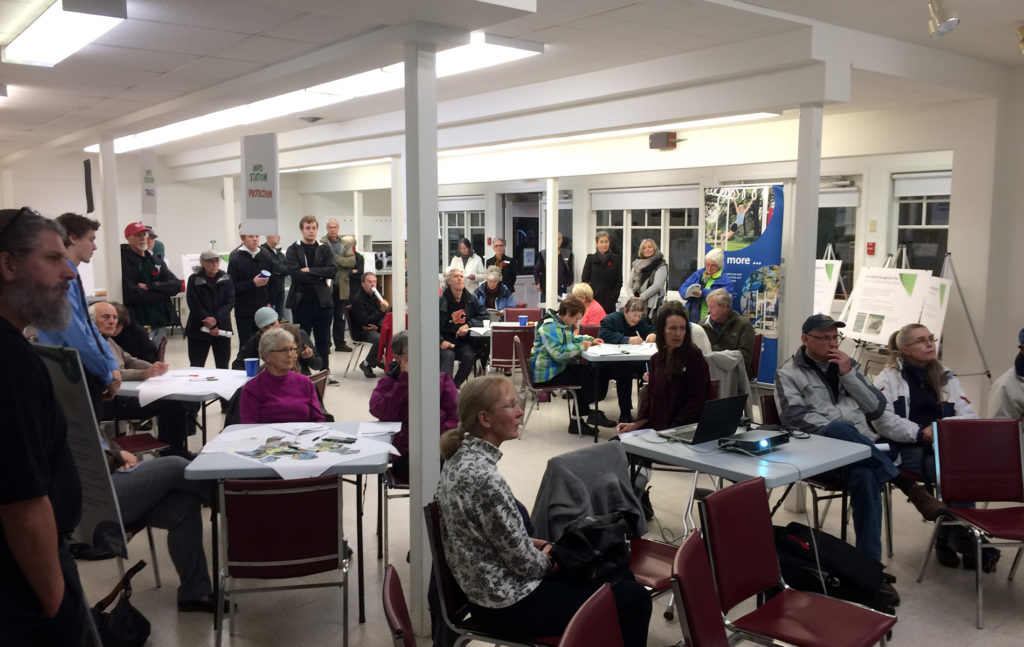
    The first public engagement strategy included field walks including an offered mindfulness forest walk and a wildlife nature walk. From this public process, we were able to return to the advisory group to finalize a vision for the community.

    The second public engagement session took the form of a world café and explored the goals that the advisory group had created. A custom-made “forest tea” was created and served. Participation continued to raise the issue of youth and young adults wanting a cycling area in the park with bike jumps. Goals were successfully refined and Saanich Parks was able to finalize a draft management plan for review and presentation to the advisory group, Saanich committees and the public .

    The third public engagement open house format included stations for each of the three most controversial goals: recreation, surface and protection, with a goal of driving residents to a survey. Presentations were made throughout the four-hour long event allowing participants to understand how we had arrived at this draft. Surveys were completed by over 400 respondents, considered a healthy success by Saanich.

    Our engagement continues as we continue to explore whether cycling in the park is possible while adhering to the established and approved vision by the community.

    To ensure accountable and transparent processes, all meeting reports are posted publicly and questions invited at any time.

    Results
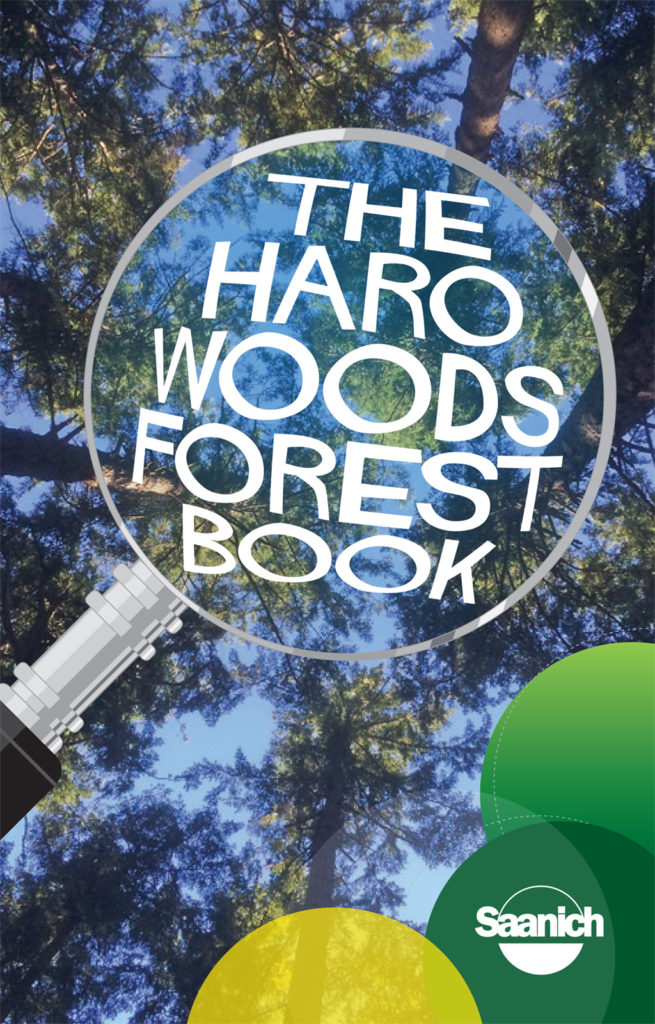
    Haro Woods - Forest Book

    While we are still in this process, success is evident with the advisory group. They had originally committed to 6 meetings. This turned into 10 meetings as we adapted to need and involve more identified stakeholders. The public events have been well attended. The client has completed a draft management plan that has been reviewed and commented upon. These insights have helped us determine the need for a different off trail biking option and our work continues on this.


    Engagement Strategy/Facilitation/Creative Direction: Valerie Elliott
    Art Direction, Design and Production: Stephan Jacob

  • Presentation to Victoria’s Partner City

    generic PDF icon

  • Situation:

    The Federation of Canadian Municipalities (FCM) aims to educate and empower municipalities across the country with sustainable concepts and processes for the management of municipal and regional assets. Currently, this is a dire issue that is not yet understood by asset managers or by municipal administrations. The issue is complex and dry to most and we needed to make engagement purposeful, educational and engaging. In addition, FCM wanted municipalities to share information. It would be necessary for them to gain trust with one another.

    Sustainability Makes CentsThe FCM brought managers from across the country to Ottawa for a two day workshop. This would be followed by six webinars to take place over a period of a year. Not all managers were able to attend therefore we needed to be able to use language that could be understood by those whose expertise was in governance or policy.

    Audience:

    Municipal asset managers, regional and municipal staff

    Solutions:

    iD2 was contracted by asset expert Kim Fowler (Sustainability Makes Cents Consulting) to create a structure that would engage. Before attendees arrived we asked them to define their level of commitment to date and their level of understanding of sustainable asset management processes.

    We discovered that few had made commitments to constituents or had experience. It was important to build familiarity and trust so despite the “academic” leaning of most attendees and contrary to the client’s intuition, we lightened up the group with icebreakers to encourage engagement.  As we learned more about attendees we adapted plans to ensure smaller municipalities could share stories and experiences, while larger municipalities could share some successes and failures. We constantly changed tactics to keep attention. We used a combination of tactile, auditory and visual tools to keep interest.

    Results:

    Evaluation from attendees of the session was extremely positive. Although the client originally didn’t think that we could succeed with “lightening up” the group, we demonstrated that outcomes could be improved by eliminating the assumption that asset managers and city staff were academics and wouldn’t have a lighter side. iD2 continues to provide advice for webinar engagement as required.

    Sustainable Asset Management Expert: Kim Fowler
    Communication and Engagement Strategy/Facilitation/Creative Direction: Valerie Elliott
    Art Direction, Design and Production: Stephan Jacob

  • Situation

    City of Victoria - Climate Action Navigator

    The City of Victoria committed to working with its partners, local businesses and residents to reduce the community’s greenhouse gas emissions by 33% by the year 2020.

    iD2 was contracted by the City of Victoria to engage with the public to articulate the new sustainability department’s goals and to help launch proprietary software that would be used in consultation with stakeholders. Climate change is a complex subject so our goal was to make information accessible and communication streams accessible to those without deep knowledge of climate change solutions.

    The software called “Climate Action Navigator” was developed by C2MP to identify effective community-wide strategies by allowing users to test their assumptions on different solutions. The tool was highly complex and inaccessible to the average person, even experienced industry experts were hindered by its complexity.

    Audience

    Climate change professionals, industry experts, city staff, climate action partners and utilities, transit authorities, businesses and Victoria residents.

    Solutions

    iD2 randomly selected and videotaped Victoria residents describe their understanding of the term “sustainability” and “resilience.”  This helped us create more effective strategies that met the needs of stakeholders and informed the choices of vocabulary used to reach different publics.

    iD2 developed and implemented an engagement strategy for internal and external audiences.  This aspect was key to the project’s success due to the diversity of audience needs. Our strategy included having decision makers be the first users of the tool so that internal stakeholders saw that this initiative was driven from the “top down.”

    We clarified potential media relations opportunities that could then be taken on by the Communications Dept. allowing them to build on their capacity to deliver outcomes. Graphics were also created throughout the process for reporting purposes.

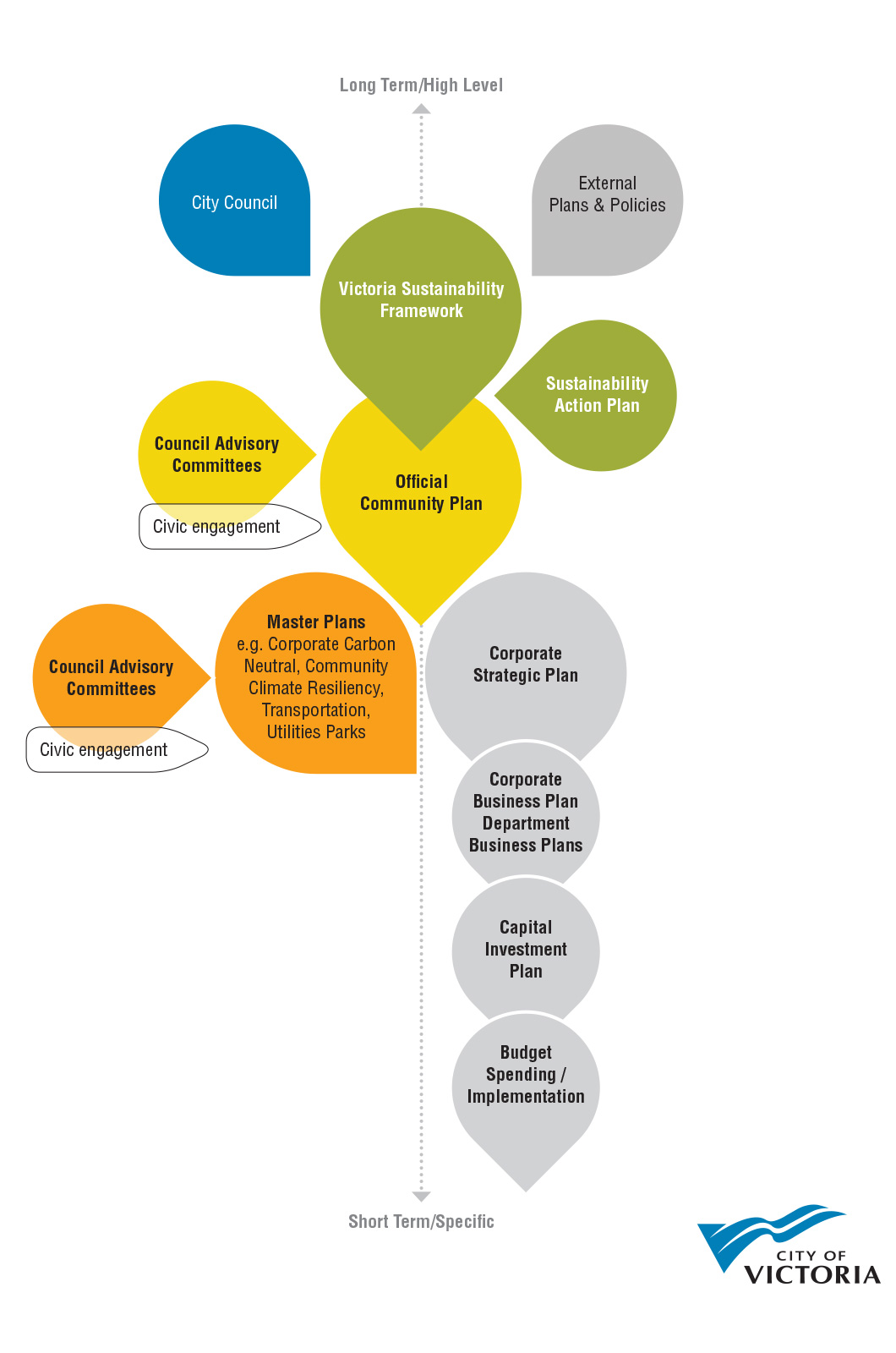
    City of Victoria - Sustainability Framework

    iD2 redesigned the software interface and rewrote copy to make the dynamic greenhouse gas quantifier software easier to use and understand for non-technical stakeholders. This ensured the City of Victoria that almost all users could experience and test climate change options.

    Results

    City of Victoria - Sustainability Framework

    The resulting work succeeded in providing the City of Victoria with a tool for engaging stakeholders. Several public and industry sessions were held.

    Climate change planning options were more easily understood by Victoria residents, while given climate change and industry professionals a tool that produced accurate results that helped them in communicating alternatives to the public.

    Although the City of Victoria dissolved the sustainability department, iD2 helped prove that through simplification and focus, even those without deep knowledge could meaningfully contribute to a discussion about the City’s climate change options. Urgent need was effectively created while stakeholders discovered for themselves the greenhouse gases reduced by investments in energy.

    City of Victoria - Sustainability Framework
    City of Victoria - Sustainability Framework
    City of Victoria - Sustainability Framework

    Project Management/Strategies/Copywriting/Creative Direction: Valerie Elliott
    Art Direction, Design and Production: Stephan Jacob